
9Views 0Comments
Why Disc Filters Are Gaining Popularity in Industrial Wastewater Treatment
Industrial plants are under more and more pressure in the present day to enhance the quality of water, lower the cost of operation, and meet stringent environmental regulations. Thus, high-end filtration is becoming the key enabling technology in many contemporary treatment plants. Among these, the disc filter wastewater treatment technology is attracting a growing attention thanks to its high filtration efficiency, small footprint, and low maintenance. Disc filters can be used, however, to remove suspended solids with less water and energy than traditional methods, and with more efficiency. They are the water magnets of this century: Promote water reuse, automation, and sustainable operation, and you get the answer: They are valuable options in the likes of manufacturing, power generation, food processing, and municipal wastewater.
What is a Disc Filter in Water Treatment?
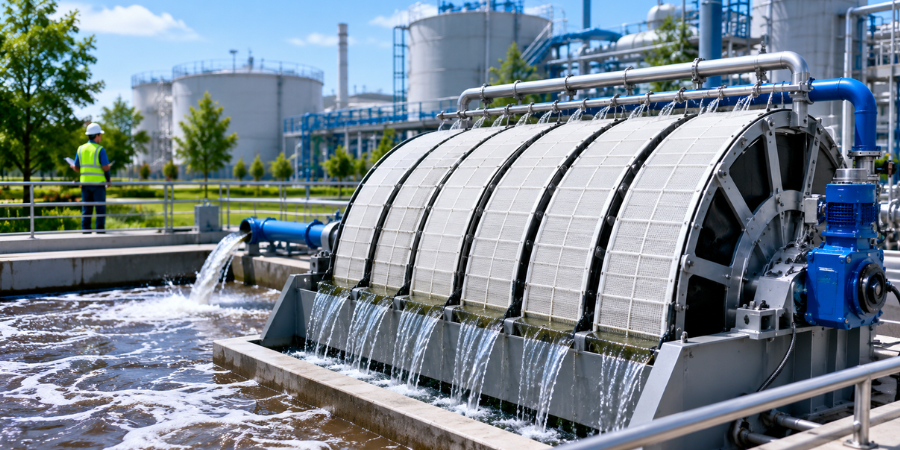
Disc filter wastewater treatment system is a high-tech filtration process for the separation of suspended solids, impurities and micronized matter in water. It is composed of a number of grooved plastic discs that are stacked together to form a very efficient filtration surface. Contaminants are trapped in the grooves as water passes through the discs, and clean water flows out. Disc filters have become the preferred solution for industrial and municipal water treatment due to their dependable performance, small footprint and outstanding filtration efficiency.
Main contrasts of the disc filter wastewater treatment system:
- It uses stacked grooved discs for filtration.
- Suspended solids and fine particles are removed.
- Can be used in industrial and waste water treatment.
- Enables automatic cleaning and backwashing.
- Consistent water quality with minimum maintenance
How Disc filter wastewater treatment Works
The working principle of disc filter wastewater treatment is the same as depth filtration. Water flows into the filter and through the compressed discs. The grooves on the discs form a pack of tiny channels to capture the particles. When the filter is clogged, a backwash cycle separates the discs and flushes away gathered dirt.
Working process:
- The filtration system is entered by raw water.
- Disc grooves trap suspended particles.
- Clean water is flowing out via the outlet.
Sensors trigger pressure change implying clogging Automatic backwashing restores the performance of the disc by cleaning it.
Key Components of Disc Filter Systems
The efficiency of disc filter wastewater treatment system relies on multiple parts, which needs to be functioning properly to ensure a smooth filtration and operation process.
Major components are as follows:
- Filter Discs Captures suspended solids and contaminants.
- Filter Housing: The disc assembly is housed in a protective casing.
- Backwash System: The discs are fully cleaned by a backwash.
- Control Units: Supervises the filtration and cleaning cycles. Inlet and Outlet
- Connections: They direct the flow of water in and out of the unit through the system.
Why Disc filter wastewater treatment is Becoming Popular
Disc filter wastewater treatment systems are being more widely used in industries as a result of increasing concerns about water availability, environmental regulations and energy efficiency. These filters offer an economical way to maintain high water quality with a minimal use of resources.
Reason for growing popularity:
- Increasing demand for water re-use Increasing demand for water recycling.
- Growing requirements for water reuse and reprocess.
- Stringent environmental regulations.
- Demand for efficient and dependable filters.
- Lower operating and maintenance costs.
- Increased efficiency compared to conventional filters.
High Filtration Efficiency and Fine Particle Removal
Among the greatest benefits of disc filter wastewater treatment is that it can be used to trap very fine particles. The profile of the disc segments allows multiple filtration layers to be created where potential contaminants are trapped.
Some advantages of filtration are:
- Elimination of fine suspended solids.
- High capacity to retain dirt.
- Stable filtration rate.
- Lower potential damage to downstream equipment Improved general water quality.
Water and Energy Efficiency Benefits
Modern industry is turning to sustainable practices and disc filter wastewater treatment systems help this cause by decreasing water and energy usage. The efficient design minimizes resource consumption without compromising the filtration properties.
Efficiency benefits:
- Less water consumption in backwash.
- Reduced energy consumption.
- Reduced operational costs.
- Increased process efficiency.
- It supports the sustainable water management practices.
Space-Saving Design for Industrial Plants
Industrial plants are frequently constrained by space. Water treatment systems using disc filters are so compact that they can be installed even if a large filtration area is not available.
Compact design that saves space:
- Smaller footprint relative to conventional filters.
- Simple installation into already existing systems.
- Perfect for retrofit applications.
- Versatile installation options.
- Minimal infrastructure needed.
Applications of Disc filter wastewater treatment Systems
The adaptability of the disc filter wastewater treatment systems and efficiency made them suitable for many industries to those which had best achieved water filtration and reuse issues. Their widespread adoption can be attributed to a number of advantages, including superior suspended solids removal, reduced maintenance, and compatibility with automated operation. Process disc filters: For process water treatment, wastewater recycling, or equipment protection, disc filters assist businesses in improving water quality and cutting down on operating expenditures.
Applications concerning disc filter wastewater treatment systems are in particular:
Textile Industry: Eliminate fibres, lint and other suspended matter in the process and waste water.

Food and drink processing: The production of clean water is subject to very high hygiene and quality standards.
Power plants: Scale and particulate control for cooling towers, boilers and heat exchangers.
Chemical and Pharmaceutical: High execution process water filtration, consistent end product quality.
Municipal Wastewater Treatment Plants: Enhances the processing of wastewater treatment and water reuse.
Irrigation Systems: Used to separate solid particles from irrigation water in farming to prevent clogging of drip irrigation and sprinklers.
Mining Applications: Removal of solids from process water for improved equipment performance and water recirculation.
Pulp & Paper Industry: Facilitates recycling of water and reduction in suspended solids in the process.
Automation and Low Maintenance Requirements
Automation is one of the key benefits of the disc filter wastewater treatment system, which makes the system favored these days in industries. Automatic monitoring and cleaning processes minimize the need for human involvement.
Maintenance benefits:
- Automatic backwashing function.
- Decreased labor expenses.
- Less downtime for cleaning.
- Longer equipment lifespan.
- Steady rate of filtration for with little supervision.
Comparison with Traditional Filtration Systems
Disc filter wastewater treatment also has many operational and performance advantages over traditional filtration systems.
Disc filtrate vs traditional filtrate:
- Higher filtration efficiency.
- Cleaning, faster and more efficacious.
- Less water used in cleaning up.
- Reduce the cost of maintenance.
- Installation is more compact Operation life is longer.
Environmental Benefits of Disc Filters
Environmental sustainability is the primary driver in the uptake of disc filter wastewater treatment technology. These filters enable industries to reduce their environmental impact while enhancing water management.
Environmental benefits:
- Less wastewater discharge.
- Enhancement of water recycling.
- Decreased energy use.
- Reduction in chemicals.
- Use with environmental-compliance objectives.
Future Trends in Disc filter wastewater treatment Technology
With the industries falling towards digital and green, the disc filter wastewater treatment technology of the future is set to get even better. Manufacturers are innovating and creating smarter, more efficient filtration solutions to keep pace with the changing needs of the industry.
Some emerging trends are:
- IoT-enabled monitoring systems
- Smart automation and predictive maintenance
- Enhanced filtration media designs
- Integration with advanced water recycling systems
- More widespread use in eco-friendly industrial systems
Conclusion
The rising demand for disc filter wastewater treatment systems is attributed to the water management solutions being efficient, sustainable and economical. High filtration efficiency, lower water and energy consumption, automated operation and easy cleaning as well as compact design are some of the advantages of the disc filters that are revolutionizing the industrial water treatment processes. Due to advancement in technology, disc filter wastewater treatment solutions are anticipated to become increasingly significant in the industry to aid in operational efficiency, regulatory compliance and long-term environmental sustainability.
FAQs
Q1. What is the application of disc filter wastewater treatment?
It is employed to eliminate suspended solids from industrial water and sewage water.
Q2. How long do discs filters last?
Just two words. Yes and no, they do need maintenance but not as often as you might be thinking.
Q3. Are disc filters better than sand filters?
Yes, they have a higher efficiency, compact size and less maintenance.
Q4. Are disc filters suitable for high-flow industrial systems?
Yes, they are scalable for high flow applications.
Q5. In which industries are disc filter systems most commonly used?
Textile, power, food processing, chemical and municipal water treatment industries.